Monday, 9 March 2026

jovi_al
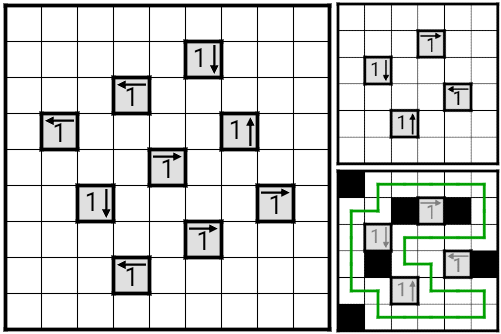
I've got a sizeable "baklog" of puzzles for you, but I'm skipping the queue with a Yajilin I made a few days ago. It comes with a tip that I think is a little trickier than our typical GAPP 101, so it has a GAPP 201! I hope this puzzle serves as a suitable introduction to an advanced technique, a la this Simple Loop by Walker and this Masyu by Lavaloid.
Rules: Shade some cells such that no clues are shaded and no two shaded cells are edge-adjacent. Draw a non-intersecting loop by connecting the centers of edge-adjacent cells such that all non-shaded and non-clue cells are visited by the loop. A clue indicates how many shaded cells are between the clue and the edge of the grid in the direction the clue's arrow points.
To earn a Speedy Sloth 🦥, solve today's puzzle in 2:30 or less!
To net a Quick Crab 🦀, solve today's puzzle in 5:40 or less!
All other solvers are welcome to their very own Counting Vampire Bat 🦇!
Example (pzprxs): https://tinyurl.com/y485esbe
Puzzle (pzprxs): https://tinyurl.com/tvcz27at
GAPP 201: In puzzle genres that disallow both dead ends and 3-way intersections where one or more paths and/or loops are drawn, one must not leave an odd number of loose ends in an area with no more potential exits.
Why is this true?
Eventually, all of the loose ends must connect to each other to reach the solved state, and when an end connects to another, it removes both it and the connected to end from the set of remaining ends. In other words, the number of remaining ends always goes up and down in pairs, and if you leave an odd number in a closed off area, there will eventually be a lone end with nothing to connect to! This class of deduction is generally referred to as "entrance counting."