Monday, 22 July 2024

Menderbug
Today is the day! The GAPP series has been running for 1000 days! To celebrate, we made a very special puzzle for you, but more on that in the next message. First things first...
We dove deep into our internal spreadsheet to get you some juicy stats across these last 1000 days! Just a note that all of these stats only include the main series and not any bonus puzzles we've published as part of the Mind the GAPP collections, nor the many example puzzles we have made.
- In total, 1039 puzzles were written across 597 different rulesets by 15 different authors.
- Together, these puzzles contain 103,389 cells, of which 99,588 were square, 1,900 were hexagonal and 1,309 were triangular (the rest are an assortment of pentagons, octagons, non-square quadrilaterals and a couple irregular cells).
- The most common grid sizes are, somewhat unsurprisingly 10x10 (359 puzzles), 9x9 (165), 8x8 (116), 7x7 (48) and 6x6 (37). But then we have our most common supersize, 18x12 (22) before 5x5 (17), which is actually tied with 18x10.
- The most commonly featured genre is tied between Nurikabe and Tapa at 10 puzzles each, followed by a three-way tie at 8 puzzles between Akari, Heyawake, and Shakashaka. If we include variant puzzles then Tapa beats Nurikabe 22 to 17, mostly thanks to last year's Tapa week. There's a big shakeup in the rest of the top 5 though, with the next base genres being Masyu (15), Slitherlink (13), and Yajilin (12).
- The most common variants (applied to any genre) are Hexagonal (23), Full, i.e. loops that visit every cell (8), and Triangular (6).
- The most commonly used bird is the Warbler (16), followed by Eagle/Owl (15), Lark (12), and Robin/Tern (11).
- Of the main team members, past and present, Eric most liked to present you with new genres (84% of his GAPPs were first-time features) while Shye preferred to hone your skills on genres you'd already seen before (46% first-time features).
And finally, here is how the puzzles break down by genre category (which is somewhat arbitrary, but it's still quite interesting):
- Line Drawing (345)
- Loop (253)
- Path (51)
- Network (26)
- Other (15)
- Shading (310)
- Other (147)
- Wall (100)
- Dynasty (63)
- Region Division (134)
- Object Placement (113)
- Number Placement (82)
- Snake (27)
- Sliding (23)
- Word Placement (5)
So here's to the next 1000 days! Do you have any feedback for us? Is there something you'd like to see us do more or less of? Now's as great a time as any to let us know.
Menderbug
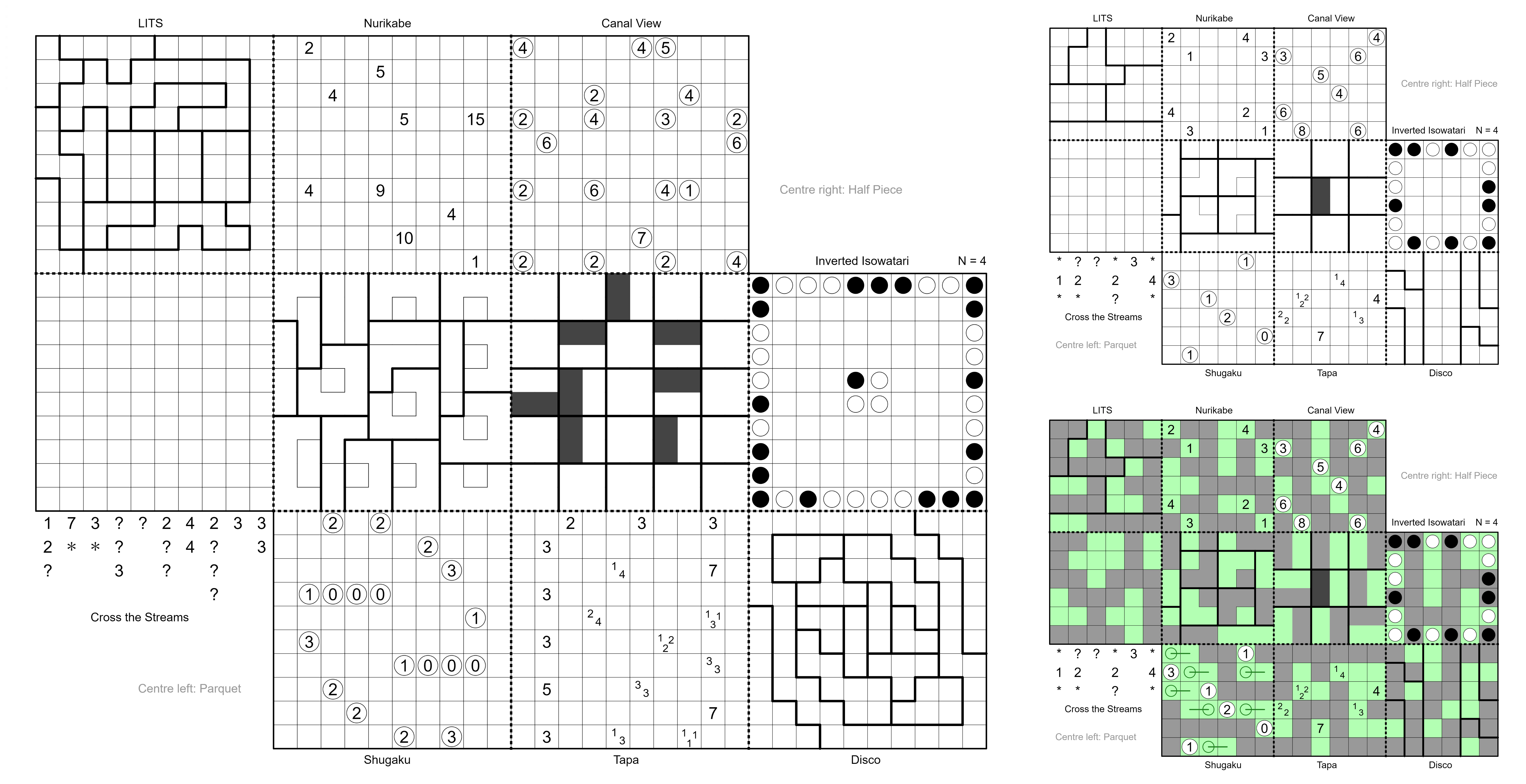
With that out of the way, it's time for today's puzzle. We wanted to make something really special for today, so the entire team put their heads together and made a puzzle with 1000 cells, mashing up ten different shading genres we've featured in the past.
Now, we do remember what the A in GAPP stands for, and by its nature this puzzle is going to be a little more intimidating than usual, but we tried our best to make this the most Approachable™️ such mashup in existence. We also assume that most of you have never solved a big mashup puzzle before, so here are a few tips to make the experience as smooth as possible:
- Familiarity with the individual genres helps a lot. All of them have been featured on GAPP before, so if any seem unfamiliar to you, you can easily find some practice puzzles. For reference, here is the latest (non-meme) appearance of each genre:
- LITS
- Nurikabe
- Canal View
- Cross the Streams
- Parquet
- Half Piece
- Isowatari
- Shugaku
- Tapa
- Disco
- Try the example puzzle! It should help you clarify how the various rulesets interact at the section boundaries. Also a quick note, there's a couple of steps in the example puzzle that are a little gnarlier than anything in the main puzzle, in the interest of showing all rules in a smaller space. Don't let that put you off the main puzzle, you can always look at the solution for the example.
- There are many entry points to this puzzle. If you get stuck, try looking for progress elsewhere.
- Mistakes are your biggest enemy in a puzzle like this. They are hard to track down and fix when there's so much puzzle to look at. Especially if this is your first mashup puzzle, don't try to race it... take your time and solve the puzzle carefully so you can be sure of your progress.
- On an interface note, since some sections use regions, we recommend using the GR or LG shades of Surface mode, as the darker grey can easily obscure region boundaries (the Penpa links should be set to GR by default).
Alright, let's get into it...
Menderbug
Rules:
Shade some cells to form a single connected area of shaded cells. No 2x2 area can be entirely shaded. Within each 10x10 section of the grid, additionally follow the rules of the indicated genre:
LITS by Lavaloid: Each region contains exactly four shaded cells, which must be orthogonally connected to each other, forming a tetromino. Two tetrominoes of the same shape may not touch orthogonally, counting rotations and reflections as the same.
Nurikabe by Freddie: Clues cannot be shaded. Every orthogonally connected area of unshaded cells which is at least partially in this section contains exactly one Nurikabe clue, the value of which represents the size of the area (including cells outside the section).
Canal View by bakpao: Clues cannot be shaded, and represent the number of shaded cells connected in a straight line horizontally or vertically to the clue. (Clues can see past the edge of this section.)
Cross the Streams by Menderbug: Clues below the grid represent the lengths of the blocks of consecutive shaded cells within this section in the corresponding column, in order. A question mark represents one block of an unknown number of cells. An asterisk represents any number of blocks of shaded cells, including none at all.
Parquet by Walker: In each bold region, entirely shade one subregion and leave the other unshaded. There may not be a closed loop of shaded cells completely contained within this section.
Note: Even though we've removed some internal borders for visual clarity, the (sub)regions are still considered to be made up of unit cells as far as the rules of neighbouring sections are concerned.
Half Piece by Lavaloid: Shade exactly one domino (two adjacent cells) in each outlined 2x2 block. Some shaded cells have been given.
Note: The genre's usual restriction on unshaded 2x2s is not used in this puzzle.
Note: Even though we've removed the internal borders for visual clarity, the blocks are still considered to be made up of four unit cells as far as the rules of neighbouring sections are concerned.
Isowatari (Inverted), N=4 by Menderbug: Black circles must be shaded and white circles must be unshaded. Groups of orthogonally connected unshaded cells which are at least partially within this section must contain exactly four cells.
Shugaku / School Trip by bakpao: Unshaded, empty cells within this section are divided into 1x2 beds, each with a pillow on one of its two cells. Each bed must be orthogonally adjacent to at least one shaded cell (which may be in an adjacent section). Clues cannot be shaded and indicate the number of pillows appearing in cells orthogonally adjacent to it. A vertically oriented bed must have its pillow on its bottom half.
Note: You can switch to Composite > Line OX to keep track of the beds. This is not required for answer check.
Tapa by Freddie: Clues cannot be shaded, and represent the lengths of the blocks of consecutive shaded cells in the (up to) eight cells surrounding the clue. (Clues can see past the edge of this section.)
Disco by Walker: Each region must contain exactly two separate orthogonally connected groups of shaded cells.
Score a Speedy Sloth 🦥 by solving the puzzle in 1.000 hour or less!
Collect a Quick Crab 🦀 by completing the puzzle in 1,000 minutes or less!
Finish the puzzle in your own time to become the proud owner of One Thousand Paper Cranes 🐦!
Example (Penpa+): https://tinyurl.com/2xpm77jk
Puzzle (Penpa+): https://tinyurl.com/2awofu5g